Nikud: the Vowel Signs
Hebrew letters are consonants. The small dots and dashes around them are the vowels. Five sounds, a dozen signs, and every word becomes readable.
You will not see nikud in newspapers or chats, but children's books, prayer books, poetry and texts for learners use it.
What nikud is and why it matters
Consonants on the line, vowels around them
The 22 Hebrew letters write consonants. The vowels are written as marks under, above or inside the letters. That system is called nikud (“dotting”).
Native readers usually skip it because they already know the words. For a learner it is the difference between guessing and reading.
The signs are added to a letter and read after it: the letter first, then its vowel.
One spelling, three words
Without nikud
ספרbook? barber? counted? Only the context tells you.
With nikud
sefer
book
sapar
barber
safar
(he) counted
Five vowel soundsa · e · i · o · u
Learn the sound, not the sign
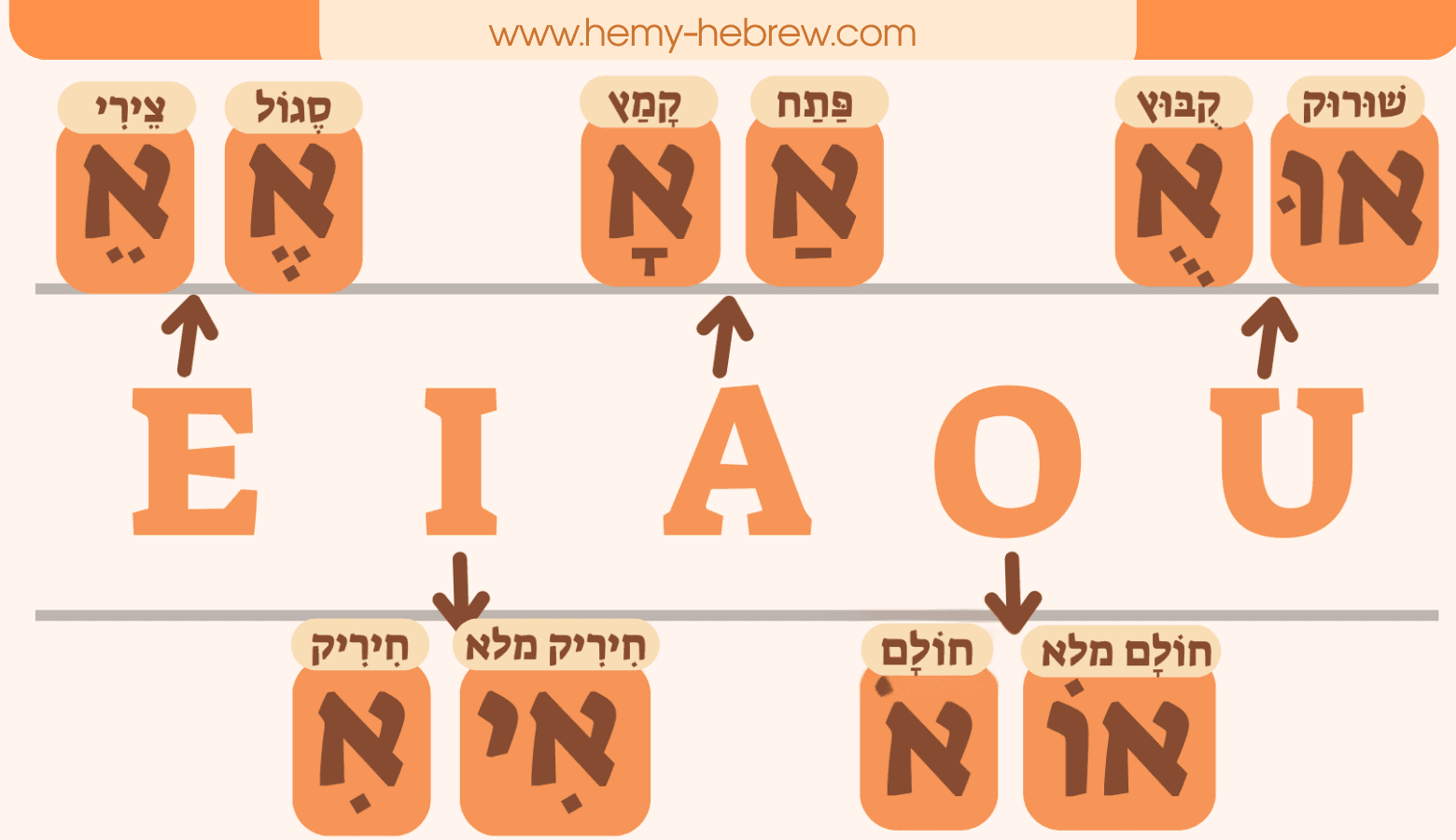
Modern Hebrew has five vowel sounds. Each sound can be written with two signs, and the difference between them is historical: today they sound the same.
So there are only five things to hear: a as in father, e as in bed, i as in ski, o as in more, u as in blue.
The letters ו and י often carry a vowel: וֹ is “o”, וּ is “u”, and י after a hirik (אִי) is “i”. They are called “mothers of reading”.
The signs by sound
a
as in father
patakh
kamats
e
as in bed
segol
tsere
i
as in ski
hirik
hirik + yod
o
as in more
holam
holam + vav
u
as in blue
shuruk
kubuts
Shown on the letter א, which is silent, so you hear the vowel alone.
Two signs you will meet right away
Under א, ה, ח and ע you often see a shva joined to a vowel sign: אֲ, אֱ, אֳ (hataf). Read it simply as a short a, e or o: אֲנִי is ani, אֱמֶת is emet.
In a few common words the kamats is read “o” instead of “a” (kamats katan), for example כָּל (kol) in כָּל יוֹם, every day, and צָהֳרַיִם (tsohorayim, noon). Learn these as words.
ani
I
emet
truth
kol yom
every day
Reading a word step by step
The slow method
Take one letter at a time: say the consonant, then its vowel, then move on. Join the syllables at the end. Slow reading now is fast reading in a month.
A letter with no vowel sign (or with a shva at the end of a syllable) closes the syllable: it is pronounced without a vowel after it.
Five words, letter by letter
a-ba
א is silent, so patakh alone gives “a”. בּ with a dagesh is “b”, and its kamats gives “ba”. The final א adds nothing: a-ba.
ge-shem
ג + segol = “ge”. שׁ (dot on the right) + segol = “she”. Final ם closes the word: ge-shem.
si-ra
ס + hirik = “si”; the following י is just part of the “i”. ר + kamats = “ra”. Final ה is silent: si-ra.
shul-khan
שׁ + kubuts = “shu”. ל carries a shva and closes the syllable: “shul”. ח + kamats = “kha”, final ן closes: shul-khan.
bo-ker tov
בּ + holam = “bo”, ק + segol = “ke”, ר closes: bo-ker. ט + holam-vav = “to”, ב without a dagesh is “v”: tov.
Quick check
How do you read this word?
שֻׁלְחָן
Silent letters, dagesh and shva
Four things that trip up readers
Once you know the vowels, four details explain almost every surprise: two letters that are silent, three letters that act as vowels, and two signs you met in the reading lesson — the dot that changes a letter's sound and the sign that can mean “no vowel”.
Silent letters: א and ע
In modern Hebrew א and ע have no sound of their own. They simply carry the vowel that is written on them.
adam
person (the א only carries the “a”)
ir
city (the ע only carries the “i”)
Letters that act as vowels: י, ו, ה
After a hirik, י spells the “i”, and ו carries the “o” or “u”; a final ה is silent. These letters stay in the word even without nikud, which is how you read unvocalised text.
shir
song (the י is part of the “i”)
shalom
hello (the ו is the “o”)
Dagesh: the dot inside
A dot inside ב, כ or פ makes them hard: b, k, p. Without it they are soft: v, kh, f. The rule of thumb: the dot appears at the start of a word and after a closed syllable.
bayit / lev
house / heart: b with the dot, v without
kelev / melakhim
dog / kings: k with the dot, kh without
pe / sefer
mouth / book: p with the dot, f without
Shva: two dots, no vowel
A shva under a letter usually means “no vowel”: the letter closes the syllable. At the start of a word it can be a very short “e”: clearly heard under י, ל, מ, נ, ר (ye-la-dim), often dropped elsewhere (sfa-rim).
shul-khan
silent shva under ל: the syllable closes
ye-la-dim
shva at the start: a quick “ye”
Tips and summary
How to practise
Read vocalised text out loud every day for five minutes: a children's book, a song lyric, the words in the game below. Say the vowels slowly and exaggerate them. Speed comes on its own.
Common mistakes
- שָׁלוֹם = shalumשָׁלוֹם = shalom
וֹ (a vav with a dot above) is “o”, not “u”. The “u” has the dot inside: וּ.
- סֵפֶר = sefer, saparסֵפֶר = sefer
Read the signs that are there, not the word you expect: סֵפֶר has tsere and segol, so it is sefer.
- יְלָדִים = yladimיְלָדִים = ye-la-dim
A shva under a first י is always heard as a short “e”: ye-la-dim, not yladim.
What to remember
- Letters are consonants; nikud writes the five vowel sounds a, e, i, o, u.
- Read one letter at a time: consonant, then vowel, then the next letter.
- א and ע are silent; י, ו and ה often stand for a vowel.
- Dagesh hardens ב, כ, פ; shva closes a syllable or gives a short “e” at the start.
Practice the words from this lesson
The same words, five ways to play. Your best score is kept on this device; sign in to earn XP and keep your streak.
Ready to Test Your Knowledge?
Match each Hebrew word to its correct English translation. Build your streak and show off your skills! 🎯
- 10 questions
Lesson test
Test yourself: Nikud (Vowels)
4 questions from the whole lesson, about 1 min. Score 70% or more and the lesson counts as done.
Tip: answer with the number keys 1–4.
How was this lesson?
Thirty seconds of your feedback shapes the next lesson.
Tap a star to start
Practise Nikud (Vowels) in the HEMY app
Games on this lesson's words and a voice conversation with AI on the same topic, so the rule turns into speech.



Scan with your phone camera
Frequently asked questions
- Do Israelis read with nikud?
- Rarely. Adults read unvocalised text because they know the words. Nikud appears in children's books, poetry, prayer books, dictionaries and learning materials.
- Do kamats and patakh sound different?
- Not in modern Israeli Hebrew: both are “a”. The same goes for segol and tsere (“e”) and for the two “o” and two “u” signs. The one exception is the kamats katan, read “o” in a few words such as כָּל יוֹם (kol yom).
- How will I read without nikud later?
- By knowing the words. Unvocalised spelling also adds extra י and ו letters to mark vowels, which is why you learn them as vowel letters now.
Finished this lesson?
Mark it complete to track your path through the grammar course.